
Spray Polyurethane Foam Roofing for Rhode Island Commercial Buildings
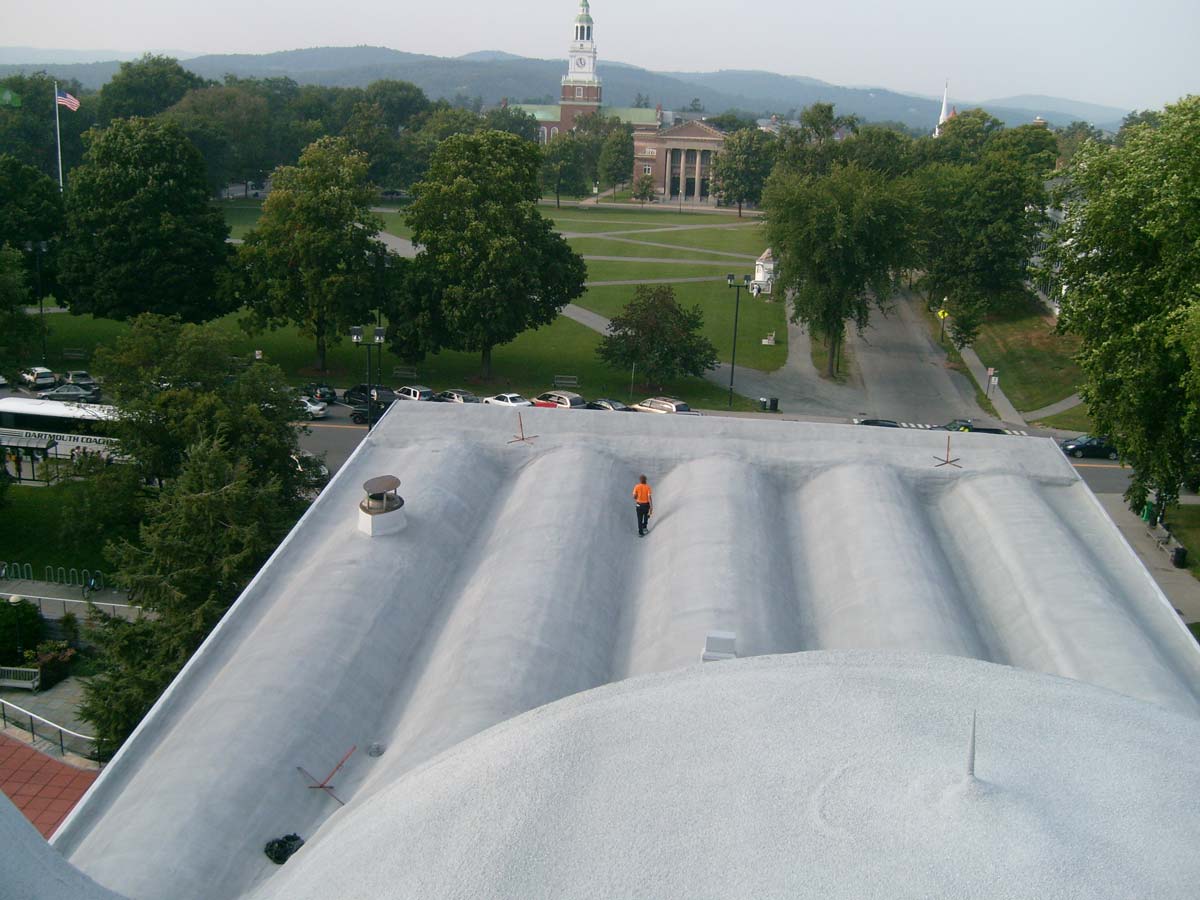
Spray polyurethane foam is the one commercial roof system that arrives as a liquid and cures into a roof. Two components are mixed at the spray gun, applied directly to the prepared deck, and expand in seconds into a closed-cell foam that hardens into a seamless, monolithic layer bonded to everything it touches. There are no laps to weld, no seams to fail, and no separate insulation step, because the foam is the insulation and the roof at the same time. A protective coating goes over the cured foam to shield it from sunlight and weather. We install, recoat, and repair SPF roofs on commercial and industrial buildings across all 39 Rhode Island cities and towns, and on the right building, particularly one with a complicated roof full of penetrations and odd shapes, it solves problems that membrane systems struggle with.
SPF is not the right answer for every roof, and we will say so when it is not. But on a low-slope roof crowded with curbs, pipes, and equipment, or on a roof with chronic ponding and an insulation problem, a seamless self-flashing foam roof can outperform a membrane in ways that matter over the long run.
What Makes a Foam Roof Different
The defining quality of SPF is that it is seamless and self-flashing. A membrane roof is a field of sheet material with seams welded or bonded between the sheets and separate flashings built at every penetration, and seams and flashings are where membrane roofs leak. Foam has neither. It is sprayed as one continuous surface that flows up and around every curb, pipe, and parapet, self-flashing each one as it goes. That single property is why SPF shines on complex roofs: a roof so cluttered with penetrations that flashing it conventionally is a nightmare becomes straightforward when the roof material simply encapsulates every obstruction in one continuous install.
Three things follow from how foam is built:
- It insulates as it roofs. Closed-cell SPF carries a high insulating value per inch, so the same layer that keeps the building dry also raises its thermal performance, which on an older commercial building with poor existing insulation is a real upgrade delivered in one step.
- It re-slopes a dead-flat roof. Because foam is applied to a thickness the installer controls, we can build it up thicker in the low spots to create positive slope toward the drains, fixing the ponding that plagues so many flat commercial roofs without tearing the structure apart.
- It adds almost no weight. Foam is light, so it can usually be added over an existing roof without overloading the deck, which makes it attractive where structural capacity is tight.
Why the Coating Is Not Optional
Cured foam by itself will not survive long exposed, because ultraviolet light degrades polyurethane. The coating is what makes a foam roof a roof. After the foam cures, we apply a protective coating, typically silicone or acrylic, that shields the foam from sunlight, sheds water, adds a reflective surface, and gives the roof its weather resistance. Silicone earns its place where ponding is chronic, because it tolerates standing water that breaks down other coatings. Acrylic is a strong reflective option where ponding is not the main concern. The coating is also what makes SPF a genuinely renewable roof: when the coating weathers down after years of service, the roof is recoated rather than replaced, restoring the protective and reflective layer over sound foam and restarting the clock without a tear-off. A foam roof that is recoated on schedule can stay in service a very long time. A foam roof whose coating is neglected fails from the top down, so we are clear with owners that the recoat is part of owning an SPF roof, not an optional extra.
Why Foam Suits the Rhode Island Climate
Several New England realities play to SPF's strengths. The insulating value matters here because Rhode Island buildings heat hard through long winters, and a roof that adds R-value while it waterproofs cuts the heating load on an older building that was never well insulated to begin with. The ability to build positive slope into the foam directly answers a chronic local problem: flat mill and warehouse roofs that pond water, where meltwater from heavy snow backs up at low spots and clogged drains and sits until it finds a way in. Rebuilding slope with foam moves that water to the drains instead of letting it stand.
Freeze-thaw is the detail that demands respect with foam, and it cuts both ways. A seamless, fully adhered foam roof with an intact coating gives water nowhere to enter and freeze, which is an advantage. But if the coating is breached and water gets into the foam, freeze-thaw will work on that breach, so coating integrity is everything in this climate. Nor'easters drive wind and rain that a continuous bonded foam surface handles well precisely because there are no seams or loose laps for the wind to catch, and the foam's bond to the deck resists uplift across the whole surface rather than at fasteners. The seamless surface is genuinely well matched to wind-driven New England weather, provided the coating is maintained.
On Aquidneck Island, in Newport, across South County, and out on Block Island, salt-laden coastal air is hard on the metal parts of any roof, and one quiet benefit of SPF is that it self-flashes penetrations in foam and coating rather than relying on as much exposed metal edge and termination hardware, though the edge details and any metal that remains still have to be specified for the salt exposure.
Where a Foam Roof Makes Sense Across the State
SPF fits a particular kind of building, and Rhode Island has plenty of them. The 19th-century textile-mill buildings in Pawtucket, Woonsocket, and West Warwick carry broad, dead-flat low-slope roofs that pond water and are often under-insulated, and they are full of old penetrations from generations of equipment, exactly the conditions where a seamless, insulating, re-sloping foam roof does its best work. The large industrial roofs at the Quonset Business Park in North Kingstown span wide areas crowded with process equipment, exhaust, and curbs that foam can encapsulate in one continuous surface. Around Providence's downtown and hospital district, foam's light weight and its ability to go over an existing roof without a full tear-off can keep occupied buildings dry with less disruption, where the roof is a suitable candidate.
Recover, Recoat, or Replace
A foam roof is often the recovery option rather than a tear-off. On a sound but tired existing roof, SPF can sometimes be applied over it after proper preparation, adding insulation, slope, and a seamless new surface without removing the old roof, which saves both the cost and the disruption of a tear-off. For an existing foam roof, the typical maintenance is the recoat: when the coating has weathered, we clean and prepare the foam, repair any damaged spots, and apply a fresh coating that restores the roof for years more. Where foam has been damaged or saturated, we cut out the bad material, replace it, and recoat, because a localized problem in foam stays local when it is caught. We are honest about when a roof is the wrong candidate for foam, an unstable or contaminated deck, the wrong substrate, or conditions that will not let the foam bond properly, because a foam roof sprayed over a bad surface fails, and that is a failure worth steering an owner away from.
How We Approach a Foam Roof
We start by assessing whether SPF is even the right system for the building. We get on the roof, check the existing surface, the drains, and the low spots, probe for saturated insulation, and confirm the deck and substrate can take a properly bonded foam application, because foam is unforgiving of a surface that is not prepared right. Application conditions matter too: foam has to be sprayed in suitable weather, so we plan the work around it. Then we lay out the options plainly, whether that is a new foam roof, a foam recovery over the existing one, a recoat of foam already in place, or, where foam is not the right answer, a different system. On occupied buildings we plan the work to keep tenants running and the interior protected.
Request a Spray Foam Roof Assessment
If you own or manage a commercial building in Rhode Island with a flat roof that ponds water, runs cold, is crowded with penetrations, or has an existing foam roof due for a recoat, an SPF system may be worth a serious look. Reach out to schedule a roof assessment, and we will give you an honest read on whether spray foam is the right fit for your building and what it would take.
 Acrylic Roof Coatings in Providence, RI
 Auto Dealership Roofing in Providence, RI
 Built Up Roofing in Providence, RI
 Church Roofing in Providence, RI
 Commercial Re-Roofing in Providence, RI
 Commercial Roof Inspection in Providence, RI
 Providence
 Warwick